
Inner Labyrinth
There is, within this series, a movement of withdrawal. Not a retreat from the world, but a displacement inward. As if each image were a step toward a denser, quieter, less nameable region of experience.
If, in Robert Frank, the photographic gesture asserted itself as drift—a journey through the world guided by intuition and friction with reality—here that drift folds back upon itself. The trajectory is no longer horizontal, but vertical. It descends.
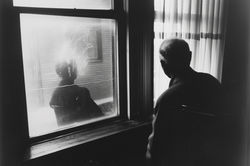
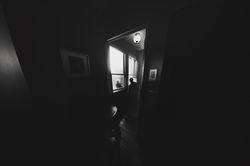
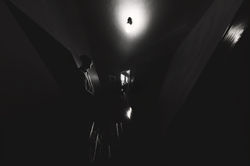
The point of departure remains recognizable: a body, a domestic interior, a window, a corridor. Fragments of reality carrying the promise of a narrative. Yet that narrative never resolves. Instead, it thickens. With each image, space narrows, light becomes scarcer, and forms begin to tilt. Architecture ceases to function as setting and begins to operate as psychic structure.
In this sense, the work resonates with Duane Michals, particularly in its ability to suggest the invisible within the image. Yet while Michals often organizes his photographs into sequences that point toward an explicit narrative construction, the sequence here remains implicit, almost subterranean. What emerges is not a story, but a sustained sensation of disorientation.
The presence of artificial intelligence intensifies this deviation. Not as a spectacular effect, but as a force that destabilizes the logic of space and light. Perspectives distort, proportions waver, shadows stretch in almost impossible ways. The image no longer describes a place; it produces a state.
There is something dreamlike here, though not in the sense of a light or comforting dream. Rather, it resembles a dense, at times opaque dreamscape, where time appears suspended and the isolated body becomes the measure of space. The subject does not move through the labyrinth; the labyrinth moves through the subject.
By testing the boundaries between photography and algorithmic construction, the series proposes an image that does not seek to assert a truth, but to experience its instability. What we see may once have existed, but no longer exists in the same way. It has been reconfigured by memory, by time, and by a technology that operates here less as a tool than as a co-author of an imaginary world.
In the end, there is no exit. Or perhaps there is no need for one. Or perhaps there is no end at all. The labyrinth is not a place to be solved, but a space to be inhabited.
 |  |  |
|---|---|---|
 |  |  |
 |  |  |