
Transe
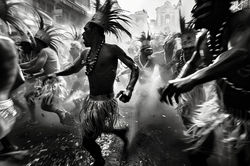
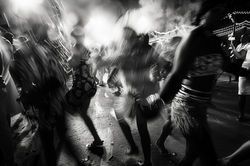
Transe revisits personal archive photographs of carnivals, not as fixed documents, but as unstable matter. Long exposures, conversion to black and white, and AI-mediated processes record the continuity of the collective experience, not its decisive moment. The series emerges from a period of physical restriction: postpartum, a mother's illness, a separation. A time when the festive body was replaced by a body governed by care and continuity. The work appropriates the logic of Carnival's dissolution to reconstruct what could not be directly experienced.
 |  |  |
|---|---|---|
 |  |  |
 |  |  |
 |  |  |
 |  |  |
 |  |  |
 |  |  |
Transe emerged from a moment of rupture and profound reconfiguration of bodily experience and presence. Developed during the postpartum period, while simultaneously navigating new motherhood, accompanying my mother's cancer treatment, and going through a marital separation, the work arose from a condition marked by exhaustion, emotional overload, and a radical restriction of one's capacity to act in the world. Within this context, the body ceased to function as a vector of freedom and instead became governed by responsibility, care, and containment. Time fragmented, experience compressed, and presence itself became diffuse.
Carnival—traditionally associated with excess, expansion, and the temporary dissolution of normative structures—appears here as a symbolic counterpoint. During the period in which the work was conceived, there was no direct participation in this collective experience. The streets were crossed only through functional journeys: medical appointments, daily tasks, necessary routes. The state of celebration had been replaced by a regime of urgency and control.
Faced with this impossibility of participation, the work begins with a gesture of return. Photographs from previous carnivals, preserved in personal archives, were revisited not as fixed documents, but as unstable material open to transformation. Memory ceased to operate as a site of preservation and became instead an active field of reconstruction.
The images, converted to black and white and often produced through long exposures, already resisted the logic of the decisive moment. Rather than fixing an event, they recorded its duration: bodies in motion, gestures dissolving, light accumulating over time. The body appears not as a stable form, but as a trace—shaped by collectivity, music, physical contact, and vertigo.
Throughout the development of the series, the work evolved through a continuous process of experimentation. The images were not produced according to a predetermined structure, but through successive attempts, approximations, and deviations.
The body of work presented in Transe therefore constitutes a fragment, an intuitive selection shaped by visual and conceptual affinities that emerged throughout the process, rather than by a fully defined initial idea. Many of the images result from the layering of different photographs, not always originating from the same context. Carnival scenes merge with portraits, isolated gestures, and fragments of other situations, creating hybrid compositions in which time and space cease to operate as continuous structures.
Elements such as smoke, feathers, shadows, sweat, and luminous particles are incorporated not as decorative additions, but as extensions of the trance state itself, intensifying the sensation of bodily dissolution and instability. Within this process, Artificial Intelligence is introduced as a second layer of mediation—not as a tool for correction or simulation of reality, but as an agent of displacement and intensification. AI acts upon the image by amplifying its instabilities, reorganizing volumes, extending blurs, and generating impossible continuities.
This operation challenges the very nature of photography. Traditionally associated with the capture and fixation of reality, the image here approaches a processual state in which multiple temporalities and layers of experience coexist within the same visual field.
The use of black and white reinforces this suspension by removing the chromatic dimension traditionally associated with Carnival and distancing it from its spectacular imagery. What remains is the materiality of gesture, light, and contrast—an experience closer to sensation than to description.
Printed as Fine Art works, the images materialize these superimpositions and visual accidents, inviting the viewer to move through a dense field where time is not linear, but condensed.
Between the physical experience that could not be lived and the image that reconfigures it, Transe establishes itself as a space of tension. A place where the body, prevented from fully inhabiting the world, comes to exist as memory, projection, and continuous transformation.
Rather than representing Carnival, the work appropriates its logic: a state in which stable forms are suspended and identities dissolve only to be reinvented. Transe thus operates both as a condition and as an imperative verb—a call to move through, by other means, what could not be experienced directly.
About the title
In Portuguese, Transe carries multiple meanings that cannot be fully translated into English. It refers to a trance state—an altered condition of consciousness associated with ritual, ecstasy, and collective experience—but it also evokes passage, transition, and transformation.
The word carries yet another resonance: as a colloquial imperative form related to a verb associated with erotic encounter, intimacy, and bodily surrender. In this sense, the title suggests not only a state of mind, but also an invitation—an injunction to cross boundaries, to enter into relation, to dissolve fixed identities through contact with others.
Transe therefore names both a condition and an action, a state of suspension and a movement toward transformation.